
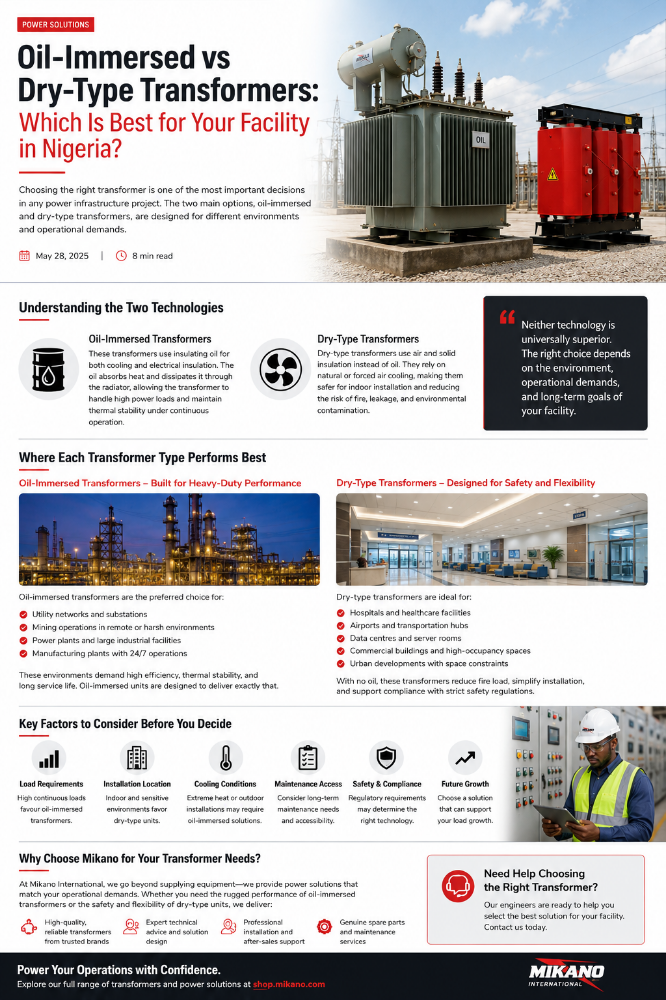
Selecting the right transformer is one of the most important decisions in any power infrastructure project. Whether for a manufacturing facility, hospital, commercial tower, data centre, or industrial plant, the transformer you choose directly affects energy efficiency, operational safety, maintenance costs, and long-term performance.
Two of the most widely used transformer technologies are oil-immersed transformers and dry-type transformers. While both serve the same fundamental purpose of voltage regulation and reliable power distribution, they are designed for very different operating environments.
Oil-immersed transformers are engineered for heavy-duty industrial applications where continuous performance, high load handling, and thermal stability are critical. On the other hand, dry-type transformers prioritize safety, indoor flexibility, and simplified maintenance, making them ideal for commercial and high-occupancy environments.
The question is not necessarily which transformer is better, but rather:
Which transformer is best suited for your facility’s operational requirements?
In this guide, we explore the differences between oil-immersed and dry-type transformers, where each technology performs best, and the key considerations businesses in Nigeria should evaluate before making an investment.
Understanding Oil-Immersed Transformers
Oil-immersed transformers use insulating oil for both cooling and electrical insulation. The oil absorbs heat generated during operation and dissipates it efficiently, enabling the transformer to handle substantial power demands over extended periods.
This makes oil-immersed transformers particularly suitable for:
- Manufacturing facilities
- Power plants
- Utility substations
- Mining operations
- Large-scale industrial environments
In sectors where downtime can lead to major operational losses, oil-immersed transformers are often preferred because of their durability, reliability, and ability to maintain thermal efficiency under continuous use.
Advantages of Oil-Immersed Transformers
- High load capacity for industrial operations
- Better thermal performance in demanding environments
- Longer operational lifespan with proper maintenance
- Suitable for outdoor and semi-outdoor installations
However, they typically require more maintenance oversight due to oil monitoring and containment requirements.
Understanding Dry-Type Transformers
Dry-type transformers operate without insulating oil. Instead, they rely on air and solid insulation systems, reducing fire risks and eliminating concerns around oil leakage.
Because of their safer operating profile, dry-type transformers are commonly installed close to occupied spaces, including:
- Hospitals
- Airports
- Data centres
- Commercial buildings
- Educational institutions
For facilities where safety compliance, indoor installation, and environmental considerations are priorities, dry-type transformers often provide a practical and efficient solution.
Advantages of Dry-Type Transformers
- Reduced fire hazards
- Minimal environmental risk from leakage
- Easier indoor installation
- Lower maintenance complexity
While they may not always match oil-immersed units in handling extremely high power loads, they excel in environments where safety and accessibility matter most.
Oil-Immersed vs Dry-Type: Key Differences
1. Cooling Mechanism
Oil-immersed transformers use insulating oil for cooling, while dry-type transformers depend on air circulation.
2. Installation Environment
Oil-immersed units are typically used outdoors or in industrial environments. Dry-type transformers are commonly installed indoors or near occupied areas.
3. Safety Considerations
Dry-type transformers generally offer lower fire risk due to the absence of oil, making them more suitable for hospitals, malls, and office complexes.
4. Performance Under Heavy Loads
For facilities requiring continuous, high-capacity power output, oil-immersed transformers often deliver stronger thermal performance.
5. Maintenance Requirements
Oil-immersed transformers require oil inspections and periodic maintenance. Dry-type transformers generally involve simpler upkeep.
Which Transformer Is Right for Your Facility?
The ideal transformer depends entirely on your operational needs.
Choose an oil-immersed transformer if your project involves:
✔ Heavy industrial operations
✔ Continuous power demand
✔ Outdoor installation
✔ Manufacturing or utility-scale infrastructure
Choose a dry-type transformer if your facility prioritizes:
✔ Indoor installation
✔ Safety compliance
✔ Minimal fire risk
✔ Commercial or public-use environments
For example, a manufacturing facility operating multiple production lines around the clock may benefit more from an oil-immersed solution. Meanwhile, a hospital, airport, or corporate building often requires the safety and flexibility offered by dry-type systems.
Key Factors to Consider Before Choosing
Before investing in a transformer, businesses should evaluate:
Load Requirements
How much electrical demand will the facility support now and in the future?
Installation Location
Will the transformer operate indoors, outdoors, or close to occupied spaces?
Maintenance Accessibility
Can routine inspections and servicing be performed efficiently?
Safety Regulations
Are there compliance requirements around fire protection or environmental safety?
Future Expansion
Will power demand increase over time?
Answering these questions early can help organizations avoid costly infrastructure upgrades later.
Why Partner with Mikano International?
At Mikano International, transformer selection goes beyond equipment supply. We help businesses align infrastructure decisions with operational demands, long-term efficiency, and project goals.
Whether your project requires the rugged reliability of oil-immersed transformers or the operational flexibility of dry-type systems, our team provides tailored power solutions designed for Nigeria’s evolving industrial and commercial landscape.
Final Thoughts
There is no one-size-fits-all answer when choosing between oil-immersed and dry-type transformers.
The best solution depends on your environment, safety priorities, load requirements, and long-term operational objectives.
By selecting the right transformer technology from the start, businesses can improve efficiency, reduce maintenance costs, and ensure more reliable power performance for years to come.
Need expert guidance on choosing the right transformer for your facility? Explore Mikano’s power solutions tailored for industrial, commercial, and infrastructure projects across Nigeria.